If you pulled up Marshall County's housing numbers recently, you saw a contradiction. The median closed price dropped 10.3 percent year over year in December 2025, settling at $200,000, the kind of headline that usually means a market cooling off. At the same time, Benton's mayor was signing off on three new residential subdivisions inside city limits and moving City Hall into a new building on River Street. Falling prices and fresh construction do not normally travel together. In Benton right now, they are.
The explanation is not that the data is wrong. It is that "Marshall County" is not one housing market. It is at least two, blended into a single county-level number that tells you less than it appears to.
One County Line, Two Housing Markets
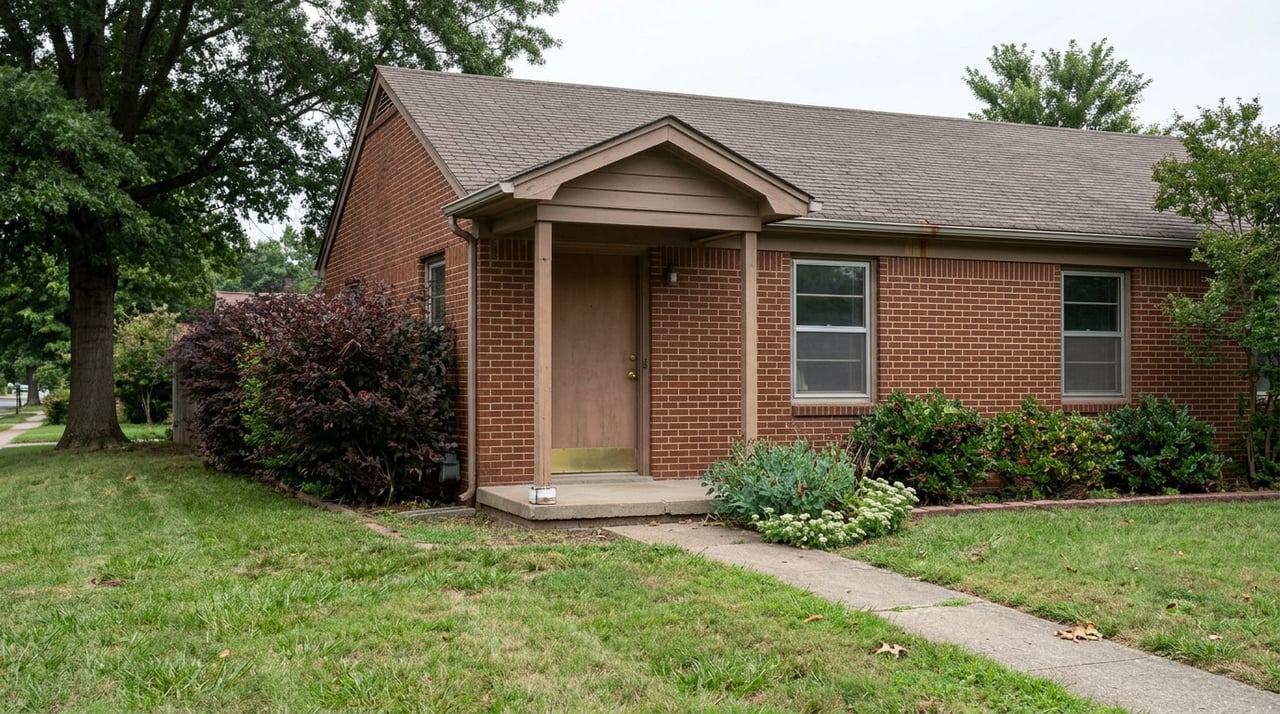
Marshall County includes Benton's courthouse square and its in-town neighborhoods, and it also includes the Kentucky Lake corridor: Jonathan Creek, Malcolm Creek, Aurora, the waterfront subdivisions that carry their own pricing logic entirely. When a county-wide statistic averages a modest in-town brick ranch with a waterfront lake cottage, the resulting median describes neither property well.
Here is what the closed-sales data actually showed for the most recent full month reported. In December 2025, homes in Marshall County sold for a median of $200,000, down 10.3 percent from the year before. But the average time those homes spent on the market fell too, from 77 days a year earlier to 50 days. Twenty-nine homes closed that month, up from 25 the December before.
Read those two numbers side by side and the "cooling market" story starts to look thin. Prices softened, but homes moved faster and more of them sold. That is not what a weakening market looks like. It is what a market looks like when it corrects toward a price that actually clears, and then clears quickly.
The Gap Between What Sellers Ask and What Buyers Pay
Now look at what is happening on the active side, in the listings currently on the market rather than the ones that already closed. As of early August 2026, the median asking price across active listings in Marshall County sits at $290,000, with those homes averaging 55 days on market and roughly 26 sales closing per month.
| Closed (Dec. 2025) | Active (early Aug. 2026) | |
|---|---|---|
| Median price | $200,000 | $290,000 |
| Avg. days on market | 50 | 55 |
| Monthly sales volume | 29 | ~26 |
The spread between that $290,000 asking median and the $200,000 closing median from December is $90,000. Some of that gap is simply seasonal drift between two different snapshots eight months apart. But the pattern is consistent with something more specific: a county where lake-adjacent inventory sits at the top of the asking range while in-town Benton properties, closer to the courthouse square and the new municipal buildings, are what is actually turning over on a normal timeline. If you are comping a property against "the Marshall County median" without first asking which side of that gap it sits on, you are comping against a number built from two different products.
What's Actually Breaking Ground Right Now
While that closed-price median was falling, the city was not slowing down. Benton Mayor Tom Farmer's year-end letter, released in early 2026, laid out three named residential projects moving forward inside city limits:
- Heritage Landing — a nine-lot single-family subdivision at the corner of Dale Avenue and River Street
- Arbors @ McNeil Creek — a quadplex and triplex development off Troy Drive
- The Prairie — a seventeen-lot single-family subdivision off Galloway Drive
None of these are waterfront projects. All three sit in or near Benton's in-town street grid, the same submarket where days on market compressed and closed prices settled lower. The same letter noted the city completed a new City Hall on River Street, an expanded Animal Services Center, a renovated police station, and new fire training and recreation facilities, all without a tax increase, alongside an estimated 400,000 visitors who spent roughly $24 million locally over the year.
Put plainly: the public and private capital moving into Benton right now is concentrated in the same in-town corridor where the closed-price median fell. That is not a coincidence. It is a bet.
Why Builders Are Pricing for Speed, Not Appreciation
A subdivision only gets built if someone believes the lots will move. Nine lots at Heritage Landing, seventeen at The Prairie, and a multi-unit build at Arbors @ McNeil Creek only make financial sense if the builder expects absorption on a predictable timeline, not a bidding war on price.
The days-on-market number from December, 50 days and falling from 77, is exactly the signal a builder would want to see before committing capital to new inventory. It says buyers are there, they are moving through the process without months of stalling, and the price point that clears is not the $290,000 county-wide asking median. It is closer to the $200,000 that actually closed. A subdivision priced and sized around that reality, rather than around the higher lake-influenced average, is a rational response to what the local data is actually showing, even while the headline county number reads as a decline.
The Pricing Trap This Creates for Sellers and Buyers
This is where the blended county statistic stops being a curiosity and starts costing people money.
A seller with an in-town Benton home who anchors their asking price to the county's $290,000 active median is pricing against comparable properties that may include lake-corridor listings with a fundamentally different buyer pool. That home is likely to sit well past the county's 55-day average, because it is competing on a number that was never built from homes like it.
A buyer who reads the 10.3 percent price decline as leverage across the board may be surprised to find in-town listings near the courthouse square moving in under two months, with multiple recent closings at speed. The decline shows up in the county's closed-sales average, but it does not mean every seller in Benton is desperate to negotiate.
The fix is not complicated, but it does require pulling the comparable sales apart by submarket rather than trusting a single blended figure. That is the same discipline behind a formal appraisal: separating a property from the county-wide statistic and testing it against sales that actually resemble it in location, access, and buyer pool. Sirk & Company has built that valuation-first approach into how the firm prices both listings and offers in Benton, treating the county number as a starting point for a conversation rather than the answer itself. If you are weighing a listing price or an offer against Benton's current numbers, a property valuation grounded in the actual submarket, not the countywide blend, is the way to avoid pricing against a number that does not describe your property.
Frequently Asked Questions
Is Benton's housing market actually slowing down? Not by the measures that usually indicate a slowdown. Days on market compressed and sales volume rose even as the closed-price median fell in December 2025. A falling median alongside faster turnover points to a market correcting toward a clearing price, not one losing buyers.
Should I compare my Benton listing to the countywide median? Only as a starting point. Marshall County's median blends in-town Benton sales with Kentucky Lake corridor sales, two segments with different buyer pools and different price behavior. A comp set limited to properties in your actual submarket will tell you more than the county figure alone.
Why would builders start new subdivisions if prices are falling? Because the metric that matters most to a builder is absorption speed, not the median price. Faster days on market and steady sales volume, both visible in the same data that showed the price decline, are the conditions that support new construction even when the headline number looks soft.
If you are trying to figure out where your Benton property, or the one you are considering, actually sits inside these numbers, contact Sirk & Company for a market read built around your specific submarket rather than the countywide average.