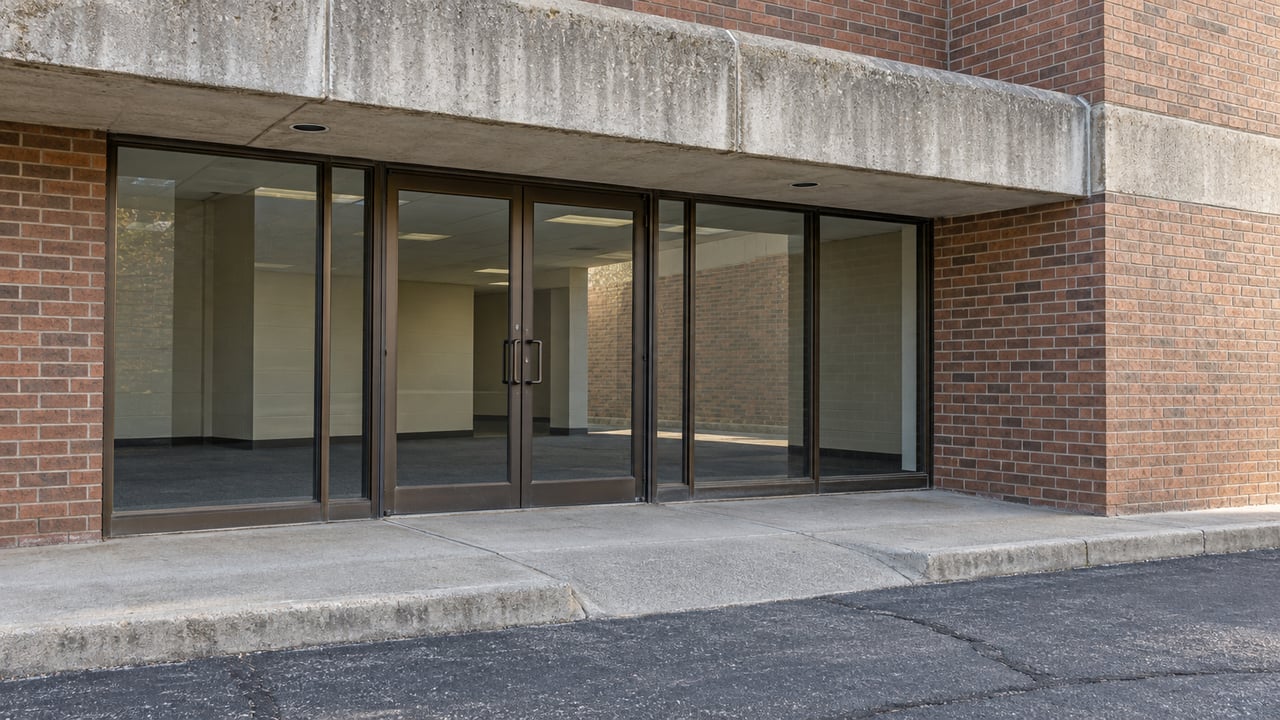
Why would a city-owned building that sits over the Ohio River in downtown Paducah, and that the city has offered to discount or transfer to a developer, still be sitting empty 17 years after it closed?
The building's condition is only part of the problem. The bigger obstacle is who owns what. The former Showroom Lounge is the one piece of the Paducah-McCracken County Convention & Expo Center that the City of Paducah owns by itself. The rest of the complex runs on a dedicated stream of hotel tax money, and that money stops at the wall the two buildings share. Anyone looking at the Showroom as an investment is really looking at a negotiation with two public bodies.
One Building, One Wall, Two Owners
On Oct. 12, the McCracken County Fiscal Court discussed the lounge. As WPSD Local 6 reported, the Showroom is "the only portion of the facility owned by the City of Paducah." Judge Executive Craig Clymer called the convention center and the lounge "a dilapidated vermin-infested facility with one common wall."
Here is how the complex divides up, based on public records and the Oct. 12 and 13 meetings:
| Component | Owner or overseer | How work gets funded | Current state |
|---|---|---|---|
| Julian Carroll Convention Center and Schroeder Expo Center | Convention Center Corporation, a volunteer board appointed jointly by the mayor and the county judge executive | Transient room tax, passed through McCracken County | Roof replacement completed; HVAC plan in place as of August 2025 |
| Former Showroom Lounge | City of Paducah alone | The city paid for its own roof section, separate from the room tax project | Closed since 2009 |
Roofing was the first time the split showed up in a budget. In October 2023, City Manager Daron Jordan explained at a city commission meeting that the city would pay for the roof section it owned, which sits level with the convention center, and that the lounge as a whole would not be reroofed. The county's room tax money paid for the rest of the roof project. At the Oct. 12 meeting, Clymer put the city's share at about $150,000 and the county's at about $2 million. He also said the county is "putting $7 million into it." Treat that as his rounded figure for the county's investment, not an itemized project budget.
How a Hotel Lounge Ended Up as a City Asset
The split dates back to the end of the Executive Inn. In October 2009, WKMS reported that the riverfront hotel had been closed for most of that year. The City of Paducah owned the land and held the hotel's lease, while the hotel's owner and its mortgage holder fought out a foreclosure in court. In October 2010, 14 News reported that crews were getting the 434-room hotel ready for demolition.
The city adopted its riverfront plan in 2013. By then, most of the Executive Inn was gone, but the meeting rooms and the riverside Showroom Lounge were still standing, attached to a convention center that no longer had a hotel next to it. The demolition removed the hotel but left one hotel space attached to a building with a different owner and a different source of money.
The Money Stops at the Wall
The convention center's funding is steady because the law limits where it can go. Under the City of Paducah's FY2027 budget, hotels collect a 4% transient room tax on gross receipts and send it to McCracken County each month. From there, 3 points go to the Convention & Visitors Bureau and 1 point goes to the Convention Center, under an interlocal agreement with the county. The tax brought in $1,804,696 in FY2025, and the revised FY2026 figure is $1,855,000.
Kentucky's statute on room taxes, KRS 91A.390, allows a special levy of up to 1% to meet the operating expenses of a convention center. It also lets the levying body, with the advice and consent of the tourist and convention commission, use a portion of receipts for the "acquisition, construction, operation, and maintenance of facilities useful in the attraction and promotion of tourist and convention business." Whether the lounge would qualify has not been decided.
The two sides described that money differently. On Oct. 12, Commissioner Eddie Jones said the room tax is a "bucket of money" that "can only be spent on the convention center," and Clymer added that it has to go to a convention center but not necessarily this one. The next evening, Mayor Pro Tem Sandra Wilson told the city commission that hotel guests pay the tax and the county only holds it. WPSD Local 6 reported that she then raised a question that bears directly on the lounge's value:
"So I think it might be a fair question to ask if money from the hotel transient tax could be used to renovate the showroom or to even demolish it, if that is the course that is decided to take."
The answer will decide whether the Showroom stays an orphan the city has to pay for alone or becomes part of the complex the room tax already supports.
Free Doesn't Mean Cheap
The city has tried to hand off the property before. Its 2019 Opportunity Zone investor prospectus includes a project sheet for the Showroom Lounge and Gourmet Dining Room. The sheet describes the building as built in the 1980s, elevated over the Ohio River in the Rivertown District, and suited to entertainment, dining, hospitality or residential use. It says the city "could be willing to discount or transfer the property to a developer/investor that has a well-conceived plan," and it names the convention center as a possible partner because that organization owns the facility next door.
Seven years later, the city's offer to discount or transfer still hasn't produced a deal. A low purchase price does little when the costs that matter come after closing. From a valuation standpoint, anyone buying a component of a building that is physically joined to another owner's structure has to price a few things the purchase price doesn't show:
- The common wall. Work on one side affects the other. Any renovation means coordinating with an owner whose board answers to both the mayor and the county judge executive.
- The roof history. The roof was replaced in sections with different payers, so a buyer has to know exactly which section they would own.
- Who controls the operating plan. The 2019 prospectus suggests the convention center might partner on the project. Bartleman, who is vice chair of the Convention Center Corporation board, has floated an open pavilion for receptions and meetings. A private use would have to work alongside whatever the neighbor wants to do.
- The funding question. If room tax money can't be spent on the lounge, every dollar of renovation has to come from the buyer or the city.
Each of these lowers what a buyer would pay, regardless of the views. The city has kept looking for a buyer. Wilson said officials have toured the space with both nonprofit and for-profit organizations, and that the city received an email asking for more information on the day of the meeting. Jordan said he personally arranged those tours as due diligence on the available options. Wilson's summary was "it's a big project."
What Changed on Oct. 12 and 13
The two meetings didn't produce a plan, a budget or a request for proposals. What changed is that both governments now say publicly that the lounge and the convention center are one issue. Clymer linked the lounge to the city's recently completed Riverfront Infrastructure Improvement Project, and Commissioner Richard Abraham called the site a chance for the city and county to work together. Wilson said the city would take part in a joint meeting about the convention center if one is needed.
The riverfront work matters here. As we wrote when the new riverfront pier opened, public money on the Paducah riverfront tends to change what private parties are willing to commit to the blocks nearby. The Showroom is still the one riverfront parcel where the public side hasn't decided what it wants.
Reading Value When the Neighbor Controls the Funding
The Showroom is an unusual case, but downtown Paducah has plenty of buildings with shared walls, split ownership and roofs maintained by more than one owner. The lesson carries over. A property attached to a well-funded neighbor is worth more or less depending on the agreements between the two owners, which can matter as much as the property's own features. Questions about cost sharing, access and coordinated repairs affect value as much as square footage or a view.
That is also why the outcome of the room tax question matters beyond this one building. If Kentucky's statute and the local interlocal agreement are read to let room tax money cover the lounge, the property gets a funding source and a likely partner. If they aren't, the Showroom has to make sense as a standalone private project attached to a public building. That is the situation it has been in since 2009, and no deal has come of it. This post is general information and not legal, tax or financial advice. Anyone weighing a transaction tied to room tax funding or a shared public structure should confirm the details with their own attorney and accountant.
Sirk & Company Real Estate has appraised and brokered commercial property in Western Kentucky since 1979, including properties where shared walls, divided ownership and public partners determine what a site is worth. If you own or are considering a downtown or riverfront property with similar complications, our commercial team and valuation services can help you work out what it is worth before you commit. Contact us to start the conversation.